Batch and Real-Time, Running Side by Side
Your morning batch verifies the whole schedule, up to 5,000 patients an hour. A walk-in shows up at 2pm anyway. Run that one check in real time without touching the batch that’s already going.
Type in a patient’s details. Get back deductible, copay, plan code, and coverage detail in seconds. Not a green checkmark that turns into a denial three weeks later.
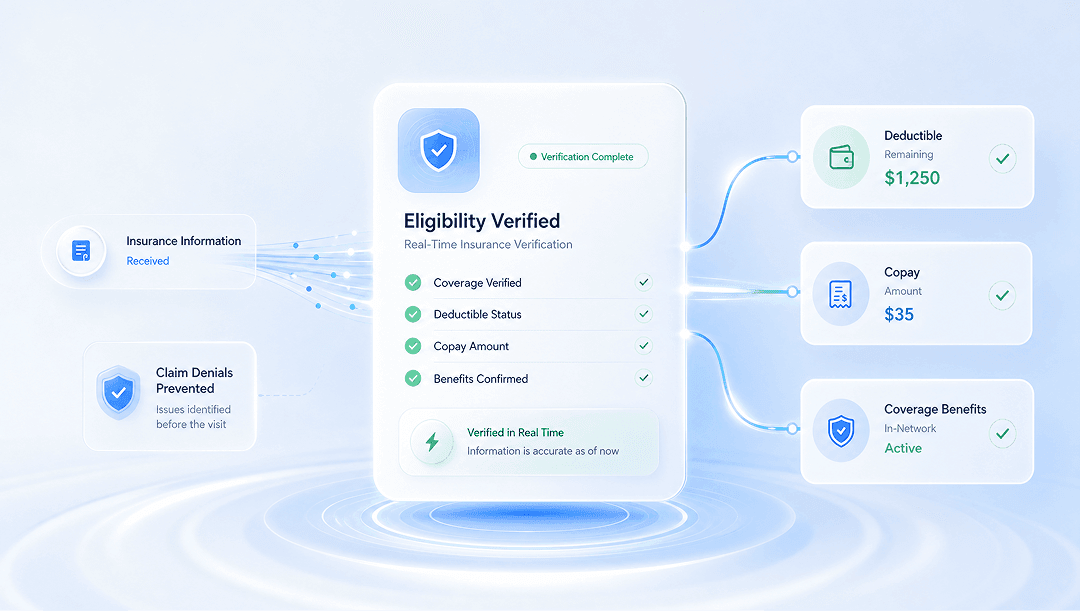







Your morning batch verifies the whole schedule, up to 5,000 patients an hour. A walk-in shows up at 2pm anyway. Run that one check in real time without touching the batch that’s already going.

Stop signing into four different systems to verify one patient. Medicare, Medicaid, commercial, all pulled through the same check. Full MCO identification included, so you know exactly which plan to bill before the claim goes out, not after it comes back denied.

Remaining deductible. Copay and coinsurance by service type. Plan code and prior-auth flags. The detail that tells you what you’ll actually collect, because “active” was never the part that stopped a denial.

Patients forget to mention the other policy. Veritable flags secondary insurance, MSP scenarios, and other primary payers before the claim goes out, not after it comes back denied.

No multi-year renewal buried in the fine print. No uphill battle if you decide to switch. You keep Veritable because it works, not because a contract won’t let you leave.

You pay for the checks you run. Nothing more. No tiers that need a sales call to decode, no invoice that looks different every month.

Add ten providers tomorrow. The rate doesn’t move. Manage every provider and every location from one account.

Real response within 24 hours. Your ticket stays open until it’s actually fixed, not until someone decides it probably is.

See exactly where a claim stands, paid, denied, pending, finalized, the moment it changes. No calling the payer, no digging through a portal to find out what already happened.
Veritable is awesome! Makes it beyond easy to see approvals for our clients and their customer service is highly responsive 5/5!
As a healthcare services company, we needed to quickly implement a state Medicaid and payer eligibility system, integrated with our practice management app. Veritable exceeded expectations, becoming true partners in the process. They rapidly turned our complex, custom requirements into functional eligibility test calls, showcasing their technical expertise and understanding of our business needs.

Real-time verification runs in under a minute while they’re still in the waiting room.
No need to wait for the next batch. Check that one patient right now.

Pull the eligibility response, confirm the plan code, submit with confidence.
Real-time detail means an actual number, not “we’ll let you know after we bill it.”
Starting at $50 a month, usage-based. You pay for the checks you run, not a seat count, not a tier you didn’t ask for, and not a contract that renews itself without telling you.
Patient data protected the way it should be. Independently audited, fully compliant, and built for healthcare from the ground up.
In 30 minutes, we’ll walk through your actual workflow, not a slide deck, and show you exactly where real-time checks slot in.
It’s the process of confirming a patient’s insurance coverage electronically, in seconds, instead of calling the payer or logging into a portal. A request goes out with the patient’s details and comes back with active status, benefit detail, and plan information, all before the patient sits down in the exam room. This is the same thing people mean when they ask “what is real-time eligibility verification,” just with the word “insurance” left out.
Every eligibility tool on the market can tell you a patient is active. That was never what caused the denial. The plan code didn’t match what the EMR needed. The behavioral carve-out didn’t show up until the claim came back. The deductible number on file wasn’t the one that applied to this visit. That happens when a check stops at “active” instead of going the rest of the way, which is why full benefit detail matters more than a yes-or-no flag.
The purpose is to confirm, before a service is rendered, that a patient’s insurance will actually pay for it. That means checking active coverage, the specific benefits tied to that visit, and anything (a prior auth requirement, a carve-out, a plan code mismatch) that could turn a clean claim into a denial. Real-time verification exists to answer that question immediately instead of after the claim has already gone out.
There are three ways, in order of how outdated they are. Call the payer directly and wait on hold. Log into the payer’s portal and pull up the patient one at a time. Or run an automated eligibility check through software like Veritable, which sends the request and returns the answer without a human doing either of the first two things.
Most real-time eligibility checks run on a HIPAA-standard 270/271 transaction. Your system sends a 270 inquiry (essentially, “is this patient covered, and for what?”) to the payer or a clearinghouse. The payer sends back a 271 response with coverage status and benefit detail. Veritable handles that exchange automatically and returns the answer in seconds instead of leaving your staff to interpret a raw transaction file.
Manual verification runs 12 minutes or more per patient once you count the portal login, the hold music, and the callback nobody returns. Multiply that by a full schedule and a front desk loses hours every day to a task that used to be a phone call and is now three tabs and a prayer. Real-time verification collapses that cost. The answer comes back before the patient finishes checking in, and it comes back with the detail that actually prevents a denial.
Active coverage status and effective dates. Remaining deductible. Copay and coinsurance by service type. Plan code and MCO identification. Prior authorization requirements. Network status for the rendering provider. Secondary insurance or coordination of benefits. Miss any one of these and the check confirmed the patient is “active,” not that the claim will get paid.
A completed check should return coverage status, remaining deductible, copay and coinsurance by service type, plan code, prior authorization flags, network status, and any secondary coverage. If a check only returns “active” or “inactive,” it isn’t giving enough detail to actually prevent a denial.
Real-time verification checks one patient the moment an answer is needed, a walk-in, a same-day add, a front-desk question. Batch verification runs an entire day’s schedule at once, usually the night before or first thing in the morning. Most practices need both. Veritable runs them in parallel, so a walk-in check doesn’t have to wait for the batch to finish.
Most major commercial payers, along with Medicaid and Medicare, support real-time eligibility (RTE) through the 270/271 transaction standard. Coverage varies by state for Medicaid and by plan for smaller regional carriers, which is why the payer list a platform connects to matters more than whether it “supports RTE” in general. Veritable connects to 1,000+ payers, including Medicaid and Medicare.
Most practices have touched at least one of three types: payer portals (Availity, individual carrier sites), clearinghouse-based tools bundled into an EHR, or dedicated eligibility platforms built specifically for verification, like Veritable, pVerify, or Waystar. The difference that actually matters is whether the platform returns full benefit detail or just an active/inactive flag, and whether staff are stuck logging into three of them to get one patient’s full picture.
Stopping at “active” instead of checking the specific benefit detail tied to the visit. Missing a secondary policy the patient didn’t mention. Billing the wrong MCO on a Medicaid managed care plan. Trusting a deductible number that reset since the last check. Skipping re-verification on a returning patient because “we already checked them” months ago. Every one of these looks fine at check-in and turns into a denial three weeks later.
It reduces the denials caused by incomplete information at the time of service, which is the majority of them. Confirming plan code, deductible status, and prior-auth requirements before the visit means the claim goes out matching what the payer expects, instead of getting kicked back for a mismatch nobody caught until it was too late.
Yes. Veritable checks Medicaid, Medicare, and 1,000+ commercial payers from the same platform, so there’s no separate login for government payers and another one for everything else.
Veritable starts at $50 a month with usage-based pricing, so you pay for the checks you actually run. No per-seat fees, no tiered contract that needs a sales call to decode, and no minimum you have to hit to avoid a penalty.
Veritable runs as a standalone platform, and most practices export their patient list from whatever EHR they already use. Real-time checks can be run one at a time from the dashboard, so there’s nothing to install and nothing that requires ripping out the current system.
No pricing page to dig through. No demo call to sit through first. Just what you'd actually pay, sent straight to your inbox.
One email. Zero spam.