8 Insurance Discovery Software Tools for Practices and RCM Teams
A billing manager at a six-provider practice has forty self-pay accounts sitting in a worklist this month. …


Your front desk makes a call every time a patient walks in. Verify eligibility right now while they’re standing there, or let it run in batch a few hours out with the rest of the day’s schedule. Most practices never actually choose this on purpose, they just do whatever the software defaults to and nobody revisits it. That’s worth fixing, because real-time and batch solve different problems. Real-time catches a lapsed policy or wrong ID at check-in, while you can still do something about it. Batch handles volume, clearing tomorrow’s whole schedule in a few hours without anyone touching each patient by hand. Pick the wrong one for the moment and you either slow down check-in for nothing, or find out about a coverage gap after the claim’s already denied. This guide breaks down when each one earns its spot in your workflow, and how the best front desk and RCM teams are running both at once instead of picking a side.
In this article, we’ll cover:
The real tradeoff isn’t speed versus savings, since both cost the same per check. It’s whether you need the answer before the patient walks away from the desk, or whether you can let the system work through a list while you do something else.
There are two ways to check a patient’s insurance eligibility, and most practices end up using both without ever sitting down to decide which one belongs where. Real-time checks hand you an answer in seconds. Batch checks process a group of patients together, usually landing somewhere in the 15 to 30 minute range, sometimes a bit longer depending on payer response times.
Here’s where it gets costly if you get the split wrong. Front desk staff who default to running a walk-in through a “quick batch check” because that’s the workflow they’re used to end up seeing that patient come and go before the result lands. If coverage turns out to be inactive, the visit already happened. Now you’re not preventing a denial, you’re appealing one. And appeals aren’t free. The Medical Group Management Association found that reworking a single denied claim runs about $25, according to research cited by the American Family Physician journal. Multiply that across a busy week of mistimed checks and it adds up fast, for a problem that a real-time check at the door would have caught before it started.
| Real-time checks | Batch checks | |
|---|---|---|
| How fast you get an answer | Seconds | 15-30 min for a few hundred patients; longer as the list grows into the thousands |
| Best moment to run it | Patient is standing at the desk right now | You're clearing a week's worth of appointments in one pass |
| How many patients it's built for | One at a time | Dozens to thousands at once |
| What happens if a check fails | You see it immediately and can act on the spot | Shows up in your results flagged for follow-up |
| What it costs | Same as batch, per check | Same as real-time, per check. No premium either way |
Real-time should be your default whenever there’s a person in front of you. That means:
If the answer needs to inform what happens in the next sixty seconds, real-time is the only tool for the job.
Batch checks earn their keep when you’re verifying a lot of patients at once and nobody’s waiting on the result right this second. Good use cases:
Most practices start out defaulting to real-time for everything, because it’s the simpler mental model. That’s fine early on. The switch to batch usually happens once you’re regularly verifying coverage for large groups at the same time, like clearing an entire week’s or month’s worth of scheduled appointments, instead of checking people one by one as they show up.
If your team is currently burning real-time checks on bulk work (refreshing your whole schedule’s coverage every week, one patient at a time), that’s the clearest sign you’re ready to try batch. Run a small group through it first before rolling it out further.
Turnaround scales with list size, from 15-30 minutes for a few hundred patients to longer for lists in the thousands. Failed checks land in your results right alongside the successful ones, so your team can go straight to the ones that need a human to look at them instead of hunting through the whole batch.
On paper, batch eligibility sounds simple. Upload a list, get answers back. In practice, a lot can go sideways between those two steps, and most of it has nothing to do with insurance.
The patient list usually comes straight out of an EHR export, and those exports rarely land in a format any checker just accepts. Someone has to reformat it, or the batch bounces.
Payers, providers, and service types have to get mapped correctly. If your tool makes you redo that mapping every time, that’s an hour gone before you’ve checked a single patient.
Somewhere in a file of five hundred rows, a handful will have a typo or a missing field. Catching those before you hit run means fixing five bad rows instead of finding out after the fact.
Once results come back, you’re often staring at a spreadsheet of hundreds of rows when you only need to act on the handful that failed. An appointment gets rescheduled and now you need to check the same list again for a new date, without re-uploading the whole file. And three weeks later, when a claim gets denied and someone asks whether coverage was checked before the visit, you need to find that answer fast, not dig through old exports.
None of that complexity is really about eligibility checking. It’s about whether the tool running your batch was built for how a front desk or RCM team actually works day to day. A batch checker that just processes a file and hands back results is only solving half the problem. The friction shows up in file prep, error handling, interruptions, and the follow-up work after.
That’s the gap a well-built batch eligibility verification tool actually needs to close.
Flexible file upload Most patient lists come straight out of an EHR export, and every EHR formats that export a little differently. A good batch tool takes the file as it comes. Nobody’s stuck reformatting columns by hand before they can even start.
Saved mappings Payers, providers, and service types only need to get set up once. After that first pass, the tool remembers it. Nobody’s rebuilding the same mapping every time they want to run a batch.
Error flagging A typo in row 400 of a 500-row file shouldn’t take down the whole run. Catching those before the batch kicks off means fixing five bad rows instead of losing the whole afternoon.
Draft save If a batch run gets interrupted, you pick back up where it left off instead of starting over from zero.
Parallel real-time checks A walk-in doesn’t wait for a batch to finish. Front desk staff need to run that one real-time check right now, while the batch for next week’s appointments keeps chugging along in the background, unaffected.
Filtered downloads Nobody wants to scroll a five-hundred-row spreadsheet looking for the ten patients who actually need a phone call. Pulling up just the Active, Inactive, or Failed rows means the team spends time on the patients who need attention, not the ones who don’t.
One-click resubmit Appointments get rescheduled constantly. Rerunning the same patient list for a new date shouldn’t mean uploading the whole file again from scratch.
Searchable batch responses A claim gets denied three weeks later and someone asks whether coverage was ever checked. Being able to pull up that exact result by patient name or date, instead of digging through old exports, is the difference between an answer in thirty seconds and an afternoon lost to the file cabinet.
That’s the real value proposition of batch eligibility checking. Handling a thousand patients in one pass is the whole point, and not every tool does it well. What separates a good one is whether that volume stays as easy to work with as a single real-time check at the front desk, without needing someone on staff who understands file formatting or payer codes to babysit it. When a tool doesn’t do that, the complexity doesn’t go away. It just moves from the payer side to your team’s afternoon, in the form of cleanup, resubmits, and digging through old files. When it does, batch stops being a specialist’s job and becomes something anyone on the front desk can run.
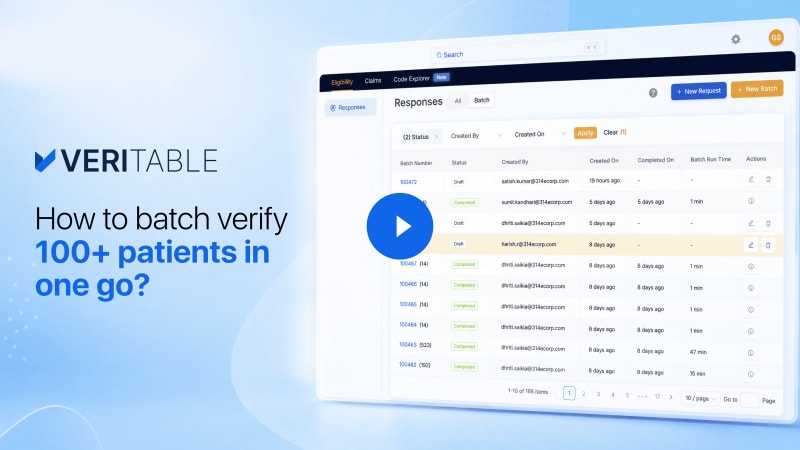
Batch checks work the same way as everything else in Veritable: you pay for what you actually run, no plan tiers to pick between. Pick a small group first, one you won’t mind keeping an eye on if something doesn’t go as expected, then scale up once the process feels routine.
Join over 3,200 subscribers and keep up-to-date with the latest innovations & best practices in Healthcare IT.
A billing manager at a six-provider practice has forty self-pay accounts sitting in a worklist this month. …
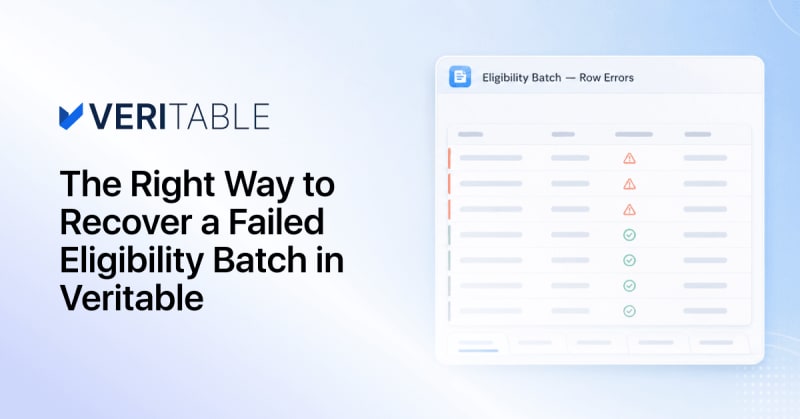
You upload the day's schedule before 8am, go do something else, and come back to a batch that didn't finish …

Here's a situation that comes up more than you'd think. Your organization's NPI record still lists a former …
No pricing page to dig through. No demo call to sit through first. Just what you'd actually pay, sent straight to your inbox.
One email. Zero spam.