
What to Do When a Medicare Patient Can’t Produce Their MBI
A Medicare patient is checking in at your front desk, and their card is still at home. Or they hand you an old …

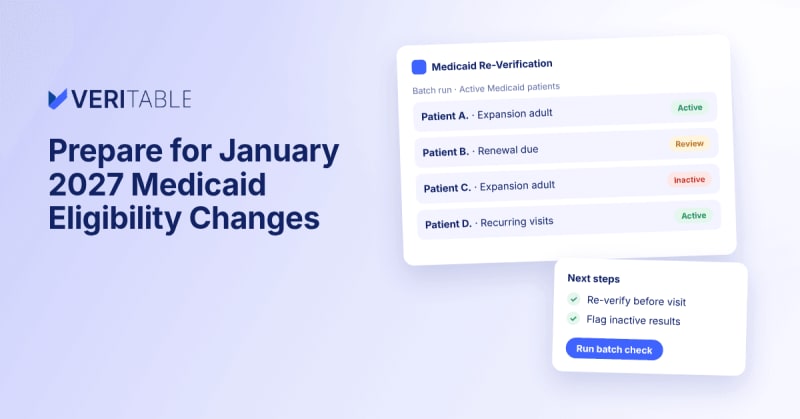
On January 2, 2027, most existing Medicaid enrollees will still have coverage. And that’s what makes the date easy to under-prepare for. Three eligibility changes take effect on January 1. Together they mean a check run months ago no longer shows whether a patient is covered today. Care given on the strength of an old check can go unpaid.
Quick Answer: H.R. 1, Public Law 119-21, makes three Medicaid eligibility changes from January 1, 2027: a work requirement and six-month renewals for expansion adults, and shorter retroactive coverage. Expansion adults are adults aged 19 to 64 covered through a state’s Medicaid expansion. Retroactive coverage is Medicaid payment for care given in the months before a patient applied. The effect is more coverage lapsing mid-treatment, and less time to recover payment when it does. Practices should re-verify on a cadence tied to renewals, check expansion adults before each visit, and bulk re-check the Medicaid panel before January.
This article will cover:
Three eligibility changes take effect on the same day, and two of them apply only to expansion adults and, in some states, to adults covered through similar section 1115 demonstrations. All three come from one federal law, which CMS calls the Working Families Tax Cut legislation.
The work requirement covers non-pregnant adults aged 19 to 64 who aren’t entitled to or enrolled in Medicare, in the Medicaid expansion group or in certain section 1115 demonstrations. To get or keep coverage, they have to show qualifying activity. CMS says 43 states and D.C. cover these adults and must put the requirement in place.
According to CMS, an adult qualifies with 80 hours a month of work, community service or a work program. Half-time enrollment in an educational program also counts. So does a combination of these, or monthly income at least equal to the federal minimum wage multiplied by 80 hours.
CMS issued its interim final rule on June 1, 2026. Under the law, states may start earlier than January 1. A state can also request a good-faith-effort extension and start later, but no extension can run past December 31, 2028.
Several groups are exempt from the work requirement. According to CMS, exemptions include adults who are medically frail, people who are pregnant or postpartum, and American Indian and Alaska Native enrollees.
Parents and caregivers of a child aged 13 or under, or of a person with a disability, are exempt as well. A patient outside these groups may still qualify for an exemption, so the state’s own criteria are the complete reference.
Expansion adults move from renewing Medicaid once a year to renewing every six months. American Indian and Alaska Native enrollees are exempt. CMS has said no state can schedule a six-month renewal before January 1, 2027. Timing still varies, because a state can either move existing enrollees’ 2027 renewals earlier in the year or switch them at their next scheduled renewal.
The change matters because each renewal is a point where coverage can lapse over missed paperwork or outdated contact information, even for a patient who still qualifies. Two renewals a year means twice as many of those points for every expansion adult on six-month renewals.
Retroactive coverage is Medicaid payment for covered care a patient received in the months before they applied, if they would have qualified at the time. From 2027 it reaches back less far. For applications on or after January 1, 2027, it drops from up to three months before the month of application to one month for expansion adults, and to two months for other Medicaid groups.
That leaves providers a much smaller window to recover payment for services given before a patient applied. Consider a patient who lapses, keeps coming in, and reapplies later. The longer the gap runs before the new application, the more of that care falls outside the window.
The work requirement is applied patient by patient, so most existing enrollees don’t lose coverage on January 1. According to CMS, states check existing enrollees at renewal, for one or more months since their last eligibility determination, and a state may choose to check more often. Patients don’t all renew on the same date, so in a state that checks only at renewal, lapses tied to the requirement arrive across the year, one renewal at a time. There’s no single day when coverage drops, which means there’s no single day to prepare for either.
In a state with an approved extension, the start is later still. The state Medicaid agency is the source for the date that applies there.
January 1 does matter in two places. New applicants have to show compliance when they apply. And the shorter retroactive window applies to every application filed on or after January 1.
Because most lapses arrive gradually, waiting is tempting, and expensive. The obvious plan is to deal with the changes when denials start showing up. But a denial is the last place a lapse appears, after the visit has happened and the claim has gone out. By then the coverage has been gone for some time, and the window to recover payment through a new application is short. Finding out at claim time means finding out with the least room left to act.
Practices can’t rely on the last visit’s eligibility check because coverage confirmed then may not hold at the next visit. Under the new rules, more patients will move between active, lapsed and re-enrolled status. Services given during a lapse get denied, and whatever the practice can’t recover becomes a self-pay balance or a write-off.
A hypothetical case shows how quietly this happens. A patient is active at one visit, and a renewal falls due before the next one. The notice goes to an old address. Coverage ends. At the next visit, the record still shows the last check as active, and the claim goes to a plan that has closed.
Practices should replace one-time checks with a repeat cadence, decide which patients get checked first, and verify in bulk. The bulk step is also the answer to staffing.
The state decides whether a patient meets the work requirement. What a practice can see is whether that patient’s coverage is active. An inactive result is the signal, whatever caused it. What helps is checking status often and acting quickly on each inactive result, rather than trying to track anyone’s compliance.
The re-verification interval should come from the two windows the new rules create, not from calendar habit. The first is the six-month renewal cycle for expansion adults. The second is the shorter retroactive window, which limits how much of a lapse a new application can recover.
Those windows set two rules. Re-verify expansion adults before each visit. Re-check everyone else in a panel-wide sweep at regular intervals.
The reason is timing. Renewal lapses happen between visits, where nobody is looking, and a lapse found after the retroactive window has passed can’t be recovered through it. There’s no single right interval for the sweep. It depends on how many of the practice’s Medicaid patients face six-month renewals and how far apart their visits are. More renewal exposure and longer gaps between visits both call for a shorter interval.
When time is short, the patients to check first are the ones whose lapse costs the most. Three groups belong at the top of the list.
Expansion adults face both the work requirement and six-month renewals, so they have the most points in a year where coverage can end. Patients with recurring or high-cost scheduled services cost more per missed check: a lapse on a recurring patient repeats at every visit until someone catches it, and a lapse on a high-cost service is expensive the first time.
New or recent applicants are the third group. They have to show compliance at application, and any care given in the months before they applied falls under the shorter retroactive window.
Checking more often doesn’t require more one-by-one portal work. The priority groups above get checked before each visit. A bulk run covers everyone else.
The method is simple. Export the list of active Medicaid patients from the practice’s electronic health record (EHR) or practice management system, run it as one batch eligibility check, and review only the patients who came back inactive. Run the first batch in December, before January 1, so the practice starts 2027 knowing who has already lapsed. Then repeat it at the cadence interval.
This is where the staffing objection usually comes up: the front desk doesn’t have time for hundreds of extra lookups. A batch run turns a lookup per patient into one list per run, and staff time goes to the inactive results, not the whole panel.
Newly inactive patients should be flagged and worked before the claim goes out. There are three ways to act: help the patient re-enroll, set up a payment plan, or find another payer.
Re-enrollment is the only one that restores Medicaid coverage, and it’s the one most sensitive to delay. The shorter retroactive window leaves little room to wait.
Start dates, renewal timing and how each state checks the work requirement all vary. Before setting a cadence, a practice should confirm three things with its state Medicaid agency: when the work requirement starts there, when six-month renewals begin, and how the state verifies compliance.
From January 2027, Medicaid coverage gets less stable, and a past check stops being evidence of coverage today. Checks have to be repeated, prioritized and run in bulk.
The work doesn’t finish in January. A state with a good-faith extension can delay the work requirement, though not past December 31, 2028, so the changes keep arriving through 2027 and 2028. A cadence set up now keeps running through all of it.
With our batch eligibility verification in Veritable, a team can upload the patient list it exports from its EHR, check hundreds of patients in one run, start it now or set it to run later, and pull out only the patients who came back inactive. When the next check is due, the same list can be re-run for a new service date without uploading it again.
Join over 3,200 subscribers and keep up-to-date with the latest innovations & best practices in Healthcare IT.
A Medicare patient is checking in at your front desk, and their card is still at home. Or they hand you an old …
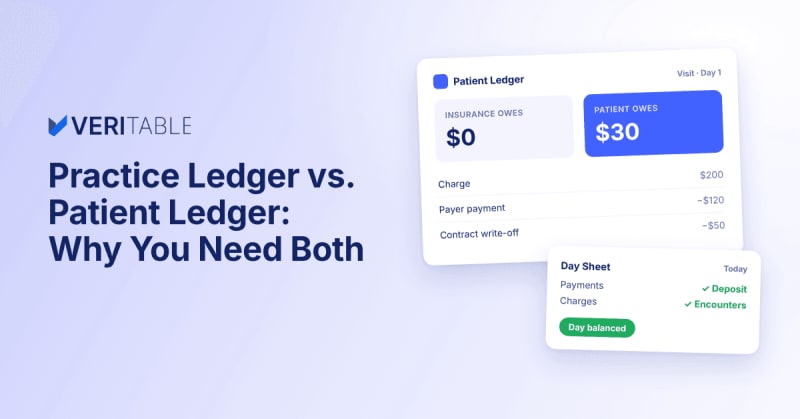
Suppose you close the day sheet and it balances. Then you open a patient's account and see a $30 balance that …

Your billers look up CPT codes all day, and most of the time it feels like a quick job: type a description, …

No pricing page to dig through. No demo call to sit through first. Just what you'd actually pay, sent straight to your inbox.
One email. Zero spam.