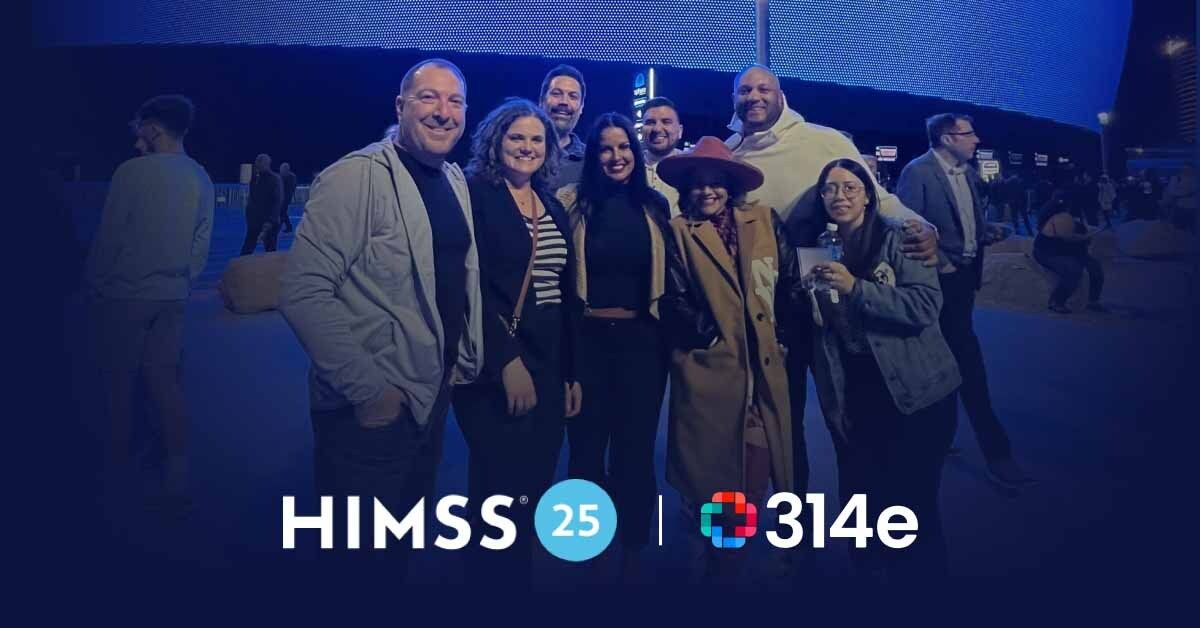
HIMSS 2025 Recap: Transforming Healthcare IT with AI-driven Automation
HIMSS 2025 was a whirlwind of groundbreaking conversations, next-gen healthcare technology, and dynamic …
Healthcare systems don’t get second chances with patient data. When a hospital replaces its Electronic Health Record (EHR) system, it must move decades of clinical history without losing a single allergy, lab result, consent form, or operative note. That responsibility sits squarely on the shoulders of IT leaders.
In a recent executive interview on This Week Health, host Bill Russell (Creator, This Week Health) spoke with Abhishek Begerhotta (CEO, 314e Corporation) about what truly drives successful EHR data migration. Russell built This Week Health with a focused mission of transforming healthcare one connection at a time. He features executives who oversee technology, manage clinical systems, and guide large-scale change inside health systems.
Abhishek Begerhotta aligns with that approach. He entered healthcare IT in the late 1990s, worked through large-scale enterprise deployments, and helped health systems convert legacy platforms into modern EHR environments. His experience spans early ambulatory systems, massive multi-state rollouts, and the data conversion work that helped move organizations from IBM-based platforms into Epic.
This article distills the key insights from that conversation and outlines what health system leaders must understand before launching an enterprise EHR data migration.
Watch full conversation:
Abhishek’s journey into healthcare IT was not part of a carefully mapped entrepreneurial vision. He began his career pursuing a PhD in mathematics at Purdue before deciding to pivot into industry during a time when academic positions were highly competitive and limited. In 1996, he joined IBM as a consultant and found himself working on an ambulatory EMR system for Kaiser Permanente. That early exposure to clinical systems during the formative years of digital health shaped the trajectory of his career.
Years later, when Kaiser transitioned from IBM’s clinical information system to Epic Systems, the shift created a pivotal moment. Rather than viewing the transition as a setback, Abhishek moved into independent consulting, focusing on data conversion work. That hands-on involvement in one of the industry’s most significant migrations eventually led to the founding of 314e. What began as a response to industry disruption evolved into a company built around solving healthcare’s most persistent data challenges.
An EHR migration may appear, on the surface, to be a change in vendor or platform. In reality, it is a high-stakes, highly technical data operation that impacts clinical continuity, compliance, and patient trust. When a health system decides to move from one EHR to another, every historical patient record must be accounted for, preserved, and made accessible under federal and state regulations. Data retention requirements can stretch up to 25 years, and organizations must be able to provide patient records in usable formats upon request.
Abhishek articulated the magnitude of the challenge clearly: “Organizations underestimate the complexity involved in taking large volumes of data from the database of an EHR vendor, understanding that schema, and then massaging it in a repeatable fashion, testing it, then getting it into their future EHR.”
The complexity lies not just in moving data but in understanding it. Legacy systems often contain deeply customized database schemas that require careful interpretation. Organizations must parse EHI exports mandated by the CURES Act, transform data into standardized formats such as HL7 or CCD, and validate every step through rigorous testing. Beyond structured data like lab results or problem lists, healthcare systems must also manage unstructured content like clinical notes, scanned documents, radiology images, and files stored in separate document management platforms. Each layer introduces new technical and operational challenges.
This is where many organizations struggle. They underestimate the effort required to extract, cleanse, test, and ingest large volumes of regulated healthcare data. Migration is not merely a technical project; it is a compliance, governance, and patient safety initiative rolled into one.
Despite the perception that large-scale EHR migrations are largely complete, the market tells a different story. According to Abhishek, there has been a significant increase in transitions from Oracle Cerner to Epic Systems. Health systems continue to consolidate onto fewer platforms, and Epic remains a dominant destination for many migrating organizations.
When asked about market trends, he responded directly: “We’re seeing a dramatic number of those,” referring to transitions from Oracle Cerner to Epic Systems. In fact, he added, “Almost always, in fact always, it is to Epic.”
These migrations are not small undertakings. Some organizations manage more than 200 terabytes of historical data, and decisions must be made about how much discrete information, often three to five years’ worth, should be fully integrated into the new EHR. While one client successfully completed a migration in six months under intense time pressure, Abhishek emphasizes that a year is typically a more realistic and manageable timeline.
The differentiator lies in process maturity. Early migrations often relied on manual scripting and ad hoc analyst efforts. Over time, companies like 314e built standardized connectors, repeatable workflows, and productized extraction methodologies. This evolution from handcrafted services to industrialized processes reduces risk, improves speed, and increases reliability across projects.
A common strategic mistake is separating data archival from discrete data conversion. Organizations sometimes treat archival as a compliance obligation and conversion as a clinical functionality issue, managing them as independent workstreams. However, Abhishek argues that approaching both simultaneously reduces cost, complexity, and duplication of effort.
“Ideally, approaching conversion and archival at the same time will reduce your cost,” he advised. Handling both simultaneously streamlines governance, reduces duplication, and prevents inconsistencies between stored and active data environments.
When archival and conversion are coordinated, governance frameworks align more effectively, validation cycles are streamlined, and organizations gain better visibility into their data lifecycle. Just as importantly, internal IT teams can remain focused on implementing and optimizing the new EHR rather than diverting attention to legacy data engineering tasks.
Timing is critical. Migration efforts cannot be compressed indefinitely, regardless of budget or staffing levels. Large data volumes, transformation logic, and validation testing require methodical execution. Starting early allows organizations to manage risk proactively rather than reactively.
Five years ago, 314e made a deliberate shift from operating primarily as a services-driven IT consultancy to becoming a product-focused company. This transition reflects a broader maturation within healthcare IT.
For 314e, this meant building intellectual property around migration workflows, archival systems, and automation platforms. The result is a more predictable delivery model, recurring revenue stability, and enhanced long-term value for customers. The pivot underscores an industry trend in which healthcare organizations increasingly prefer battle-tested platforms rather than one-off consulting solutions.
EHR Training remains one of healthcare IT’s most persistent friction points. Traditional learning management systems often house extensive educational materials, but those resources are rarely accessed at the exact moment a clinician needs support. As a result, users either struggle through workflows or log help desk tickets, creating operational delays.
314e’s just-in-time training platform reimagines this model by embedding short-form instructional content directly within the EHR environment. Inspired by modern content consumption habits, the system delivers concise, two-minute videos, standardized through AI-generated voiceovers. These videos can automatically generate written tip sheets, and users can interact with the content via chat-based interfaces. If automated responses fall short, the system allows escalation to human support.
This approach addresses not just knowledge gaps but accessibility gaps. By bringing learning directly into the workflow, organizations reduce friction, decrease help desk volume, and improve clinician efficiency. The shift represents a broader recognition that usability and accessibility are as important as content quality.
Document management has historically been labor-intensive within healthcare. Staff members manually index scanned forms, process faxes, and route documents through complex workflows. The advent of Large Language Models (LLMs) has significantly expanded what is possible in this domain.
314e’s Intelligent Document Processing (IDP) platform leverages AI to classify documents, extract key entities, and execute conditional workflow logic. Documents entering through scans, faxes, emails, HL7 feeds, or X12 transactions can be automatically categorized and routed based on content. SMART on FHIR integrations enable tighter connections with EHR systems.
In practical terms, automation can reduce manual indexing workloads dramatically. Teams that once required large staffing levels can now operate with smaller oversight groups focused on quality assurance rather than repetitive entry tasks. This is not speculative AI experimentation; it is operational automation integrated into existing healthcare workflows.
The healthcare IT landscape remains dynamic. Large health systems continue to migrate platforms, consolidate document management tools, and explore AI-driven optimization strategies. Market consolidation toward Epic persists, and modernization efforts show no sign of slowing.
These shifts reveal that healthcare IT has not reached equilibrium. Organizations are still modernizing foundational infrastructure, managing legacy complexity, and integrating emerging technologies. Data strategy sits at the center of all these initiatives.
For CIOs evaluating an EHR migration or grappling with legacy data challenges, the overarching message is clear: start early and plan deliberately. Migration projects are constrained by technical realities that cannot be bypassed through urgency alone. Data complexity, regulatory requirements, and validation processes demand time and expertise.
As Abhishek quotes it, “Start early enough… you just cannot accelerate it.”
Equally important is recognizing that archival and conversion are not peripheral concerns; they are core infrastructure decisions. Engaging specialists who focus exclusively on these domains allows internal teams to concentrate on implementing and optimizing the new system.
Ultimately, successful digital transformation in healthcare is not about replacing software. It is about preserving, structuring, and activating data in ways that protect patients, support clinicians, and enable long-term operational resilience.
Healthcare’s future will not be defined solely by new platforms or AI buzzwords. It will be defined by how well organizations manage the data beneath those systems, and how thoughtfully they approach the transitions that shape the next generation of care delivery.
Join over 3,200 subscribers and keep up-to-date with the latest innovations & best practices in Healthcare IT.
HIMSS 2025 was a whirlwind of groundbreaking conversations, next-gen healthcare technology, and dynamic …

314e Corporation, a leader in healthcare information technology services and solutions, achieved two top 4 …

AI in healthcare IT - a buzzing topic that's as exciting as it is daunting.
Recently, on August 8th, …