How to Create a Strategy for Data Extraction, Migration, and Archival While Switching to an EHR
The process of legacy EHR system retirement can bring a host of challenges. Multiple questions arise as a …
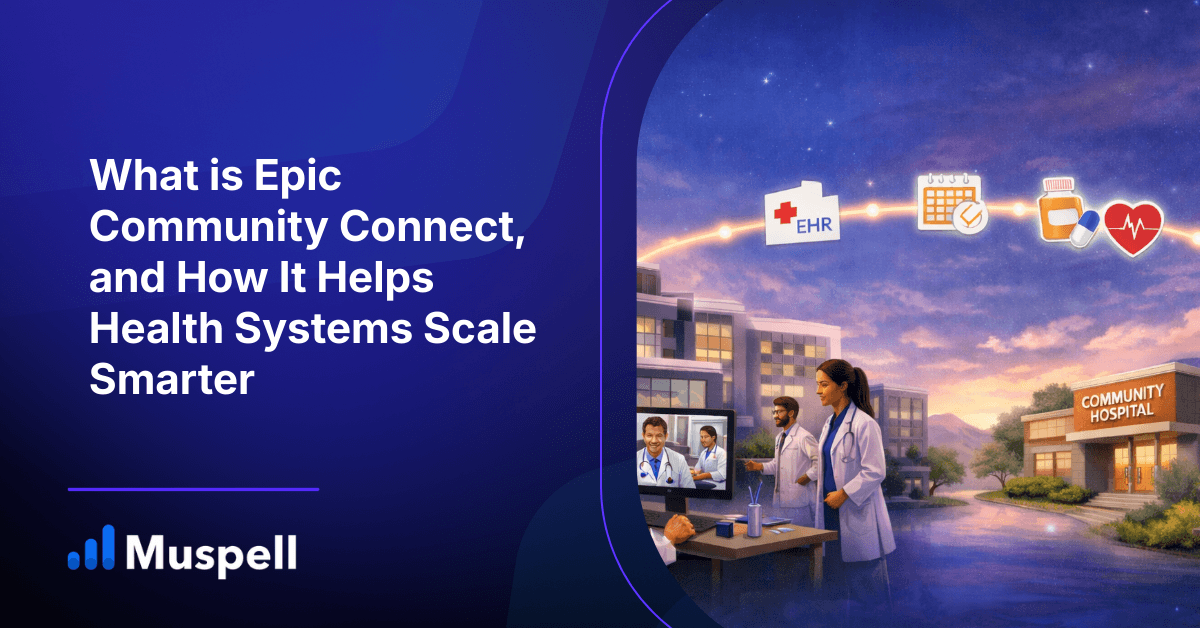
Health systems are under increasing pressure to extend clinical, financial, and operational integration beyond their core enterprise. Community hospitals, specialty clinics, and newly acquired affiliates need modern EHR capabilities, but often lack the capital, infrastructure, and IT workforce to implement and manage a full Epic instance independently. Healthcare leadership teams need a model that strengthens integration without multiplying cost and complexity.
Epic Community Connect gives them that model.
Epic Community Connect has emerged as a strategic model for extending Epic’s platform across a broader care network without fragmenting systems or data. But while it offers powerful benefits, its long-term success hinges on governance, infrastructure alignment, and data migration and archival strategy. This guide explores what Epic Community Connect is, how it works, the strategic advantages it offers, the implementation challenges leaders must anticipate, and how to future-proof your approach.
Explore:
1. What Is Epic Community Connect and Why Does It Matter?
2. How Epic Community Connect Works Inside the Epic Ecosystem
3. How Is Community Connect Different from a Standard Epic Implementation?
4. Why Community Hospitals Are Turning to Epic Connect
5. Strategic Benefits of Epic Community Connect
6. The Biggest Challenges in Epic Community Connect Implementations
7. How CIOs Should Approach Epic Community Connect Strategically
8. The Critical Role of Data Migration and Archiving in Community Connect Success
9. Future-Proofing Your Epic Community Connect Strategy
10. How Health Systems Can Scale Community Connect Successfully
Epic Community Connect is a program developed by Epic Systems that allows a larger health system (the “host”) to extend its Epic platform to affiliated community providers and hospitals.
Instead of each organization running its own EHR system, affiliates operate within the host’s Epic environment, sharing infrastructure, governance models, and, often, clinical workflows. This unified model reduces fragmentation and improves care coordination across the network.
For community hospitals, this approach provides access to enterprise-grade technology without the full burden of independent ownership. For host systems, it strengthens strategic alignment, improves interoperability, and supports long-term growth initiatives.
Under Community Connect, the host health system owns and manages the Epic instance while affiliates operate within that shared environment under defined governance agreements. Infrastructure, upgrades, cybersecurity, and core architecture are centrally managed, ensuring consistency and reducing duplication of effort across the network.
Clinical workflows are typically standardized to promote quality and operational alignment, though limited configuration may be allowed to address local requirements. Financial and operational agreements define cost-sharing structures, service-level expectations, and accountability frameworks.
Unlike a traditional IT deployment, Community Connect is fundamentally an operating model decision. It influences governance structures, reporting hierarchies, and long-term strategic priorities across both host and affiliate organizations.
A standard Epic implementation gives an organization full autonomy. The health system independently owns its data, infrastructure, governance model, and upgrade cycles. Strategic and operational decisions remain fully internal, with no shared dependencies.
In contrast, Community Connect operates within a shared enterprise framework. Infrastructure is centralized, governance is host-led with affiliate input, and interoperability is aligned across the broader network strategy. While this reduces infrastructure burden and cost for affiliates, it also introduces coordinated decision-making and shared accountability.
For community hospitals without enterprise scale, the Community Connect model often makes financial and operational sense. However, it requires thoughtful planning to balance shared control with local operational needs.
Many community hospitals continue to operate legacy EHR systems that rely on aging infrastructure, limited integration capabilities, and outdated security frameworks. These environments often carry rising maintenance costs and significant cybersecurity risk while placing strain on already limited IT staffing resources.
By joining a host system through Community Connect, these hospitals gain access to modernized clinical workflows, enterprise-grade cybersecurity protections, and integrated interoperability across a broader care network. They also benefit from shared IT expertise and economies of scale that would be difficult to achieve independently.
This shift aligns with broader consolidation trends in U.S. healthcare, where regional systems are expanding through acquisitions and affiliations. Community Connect provides a structured pathway for integrating newly affiliated organizations without creating additional system fragmentation.
Clinical standardization allows health systems to align order sets, documentation templates, and care pathways across multiple facilities. This reduces unwarranted variation in care delivery and supports enterprise-wide quality initiatives. For healthcare leaders, a shared Epic environment strengthens oversight and enables more consistent reporting and benchmarking.
Centralized hosting and support services reduce redundant infrastructure investments and minimize duplication of IT resources. Instead of maintaining multiple data centers and independent upgrade cycles, organizations consolidate efforts into a single, coordinated platform. This allows IT teams to focus on optimization, innovation, and clinician support rather than basic system maintenance.
Revenue cycle processes benefit from standardization and shared reporting structures. Community affiliates gain access to advanced financial tools, analytics capabilities, and performance dashboards that might otherwise be inaccessible due to cost or staffing constraints. Greater transparency across the network enhances accountability and supports stronger financial performance.
Community Connect also serves as a strategic enabler for mergers and acquisitions. By providing a repeatable integration model, host systems can onboard new affiliates more efficiently and reduce the time required to achieve operational alignment. This scalability becomes a competitive advantage in markets experiencing rapid consolidation.
Despite its advantages, Community Connect implementations require careful planning and cross-functional coordination.
Most community hospitals entering Community Connect are transitioning from older EHR platforms, custom-built applications, or hybrid paper-digital environments. These systems often contain decades of clinical, financial, and operational data stored in inconsistent formats.
Leaders must determine what historical data should be fully converted into Epic, what should be archived, and what must remain accessible for regulatory compliance. Without a structured framework, organizations risk incomplete records, clinical disruption, audit exposure, and provider dissatisfaction. Data migration must therefore be treated as a strategic initiative rather than a technical afterthought.
Healthcare organizations are subject to extensive federal and state retention requirements. Even after go-live in Epic, legacy data remains governed by HIPAA, audit standards, legal hold obligations, and payer contract requirements.
Without a clear archival strategy, organizations may keep legacy systems operational solely to access historical records. This approach increases infrastructure cost, expands cybersecurity exposure, and complicates compliance oversight. A structured archival model allows organizations to preserve required data while decommissioning outdated systems.
Community Connect requires clear definitions of data ownership, access controls, reporting boundaries, and change management authority. Host systems must lead governance frameworks while ensuring affiliates maintain appropriate operational visibility and autonomy.
If governance roles are not clearly defined early, disputes over reporting access, configuration changes, or data segmentation can delay projects and erode trust. Strong governance structures are essential for long-term scalability.
Standardization often requires affiliates to adapt long-standing local workflows. While this ultimately improves efficiency and quality alignment, it can generate resistance if not managed carefully.
Engagement with clinical leadership, structured training programs, and transparent communication are critical to achieving provider buy-in. Successful organizations treat change management as a core pillar of implementation rather than a secondary activity.
Successful Community Connect programs share several consistent characteristics.
Before onboarding an affiliate, organizations should assess infrastructure maturity, inventory legacy applications, evaluate data quality, and identify integration dependencies. A thorough understanding of the current-state ecosystem helps prevent unexpected complications during migration and integration.
Data governance decisions must be clarified at the outset. Organizations should determine how affiliate data will be segmented, how shared reporting environments will function, and what happens to data if an affiliate exits the agreement. These structural decisions influence long-term scalability and risk management.
Integration with ancillary systems, including laboratory, radiology, pharmacy, and revenue cycle platforms, should be mapped early in the planning process. Proactive interface design reduces last-minute development work and lowers project risk.
One of the most overlooked aspects of the Community Connect strategy is the disposition of legacy systems after go-live. Maintaining old platforms solely for historical access increases cost and security exposure.
A structured archival approach extracts relevant historical data, preserves clinical context, enables read-only access, maintains regulatory compliance, and supports decommissioning of outdated infrastructure. Addressing archival strategy early prevents long-term operational burdens.
For executive leadership, data strategy should be viewed as foundational rather than operational.
Clinicians require longitudinal patient records to deliver informed care. Finance teams depend on historical billing data for reconciliation and reporting. Compliance leaders require defensible audit trails to meet regulatory obligations.
If migration planning focuses only on immediate go-live functionality, organizations may create long-term inefficiencies that undermine operational performance and increase risk exposure.
Poor archival planning can result in multiple unsupported systems remaining operational, fragmented data environments, expanded cybersecurity vulnerabilities, and increased audit complexity. Infrastructure costs accumulate over time, particularly as additional affiliates are onboarded.
In large network expansions, these risks compound with each new integration, making early strategic planning essential.
Leading organizations begin with comprehensive data inventory and classification processes. They establish clear frameworks for deciding which data should be converted versus archived and implement rigorous validation and reconciliation protocols.
Retention policies must align with governance standards, and archival strategies should support both structured and unstructured data types. A disciplined approach ensures clinical continuity while reducing unnecessary system duplication.
Hybrid archival strategies often combine selective data conversion into Epic with external archival repositories or read-only legacy viewers. Some organizations implement FHIR-enabled structured access layers to preserve interoperability while minimizing infrastructure overhead. Secure cloud-based storage environments can further reduce cost and improve scalability.
These hybrid approaches allow health systems to sunset expensive legacy platforms while maintaining compliance, accessibility, and clinical continuity.
Community Connect initiatives often serve as a foundation for ongoing network growth rather than a single integration event.
Each new affiliate introduces additional data sets, unique workflows, and governance considerations. Scalable architecture and repeatable migration frameworks are essential to maintaining consistency and controlling risk as the network expands.
As consolidation accelerates, organizations benefit from standardized onboarding playbooks. A repeatable Community Connect framework, supported by structured data migration processes, reduces time-to-integration and improves post-acquisition stability.
Longitudinal data continuity is critical for predictive analytics, population health management, risk stratification, and quality improvement initiatives. Fragmented legacy data environments undermine enterprise analytics strategies and limit the effectiveness of AI-driven insights.
CIOs must balance centralized control with affiliate autonomy while maintaining robust data privacy protections and cybersecurity resilience. A mature governance model supports compliance, operational stability, and future growth.
To scale successfully, organizations should treat Community Connect as a strategic growth platform rather than a standalone IT project. Data migration and archival planning must be embedded in early implementation phases, and enterprise-level governance frameworks should be established before onboarding affiliates.
Creating repeatable integration models reduces risk in future expansions, while partnerships with experienced data migration and archival specialists can further mitigate long-term operational and compliance exposure.
When executed strategically, Epic Community Connect becomes a powerful enabler of network alignment, financial performance, and clinical excellence. When implemented without comprehensive data planning, it can create hidden operational and compliance burdens that persist for years.
Epic Community Connect offers a compelling model for extending enterprise-grade EHR capabilities across community networks. For CIOs and healthcare IT leaders, it represents both opportunity and responsibility.
The organizations that succeed are those that align governance early, standardize workflows strategically, plan infrastructure deliberately, and prioritize data migration and archival as core pillars of implementation.
Community Connect is not simply about expanding Epic access. It is about building a sustainable, scalable digital foundation for the future of healthcare delivery.
For health systems evaluating or scaling Community Connect, ensuring that legacy data is migrated intelligently and archived compliantly may be one of the most consequential strategic decisions they make.
Join over 3,200 subscribers and keep up-to-date with the latest innovations & best practices in Healthcare IT.
The process of legacy EHR system retirement can bring a host of challenges. Multiple questions arise as a …
For healthcare organizations moving from Cerner Millennium to Epic, the earliest planning conversations …
Healthcare data archival offers healthcare leaders significant potential for reducing costs. Integrating a …