
Getting Healthcare Application Sunsetting Right During M and As
With the increased need to provide value-based care, the healthcare industry has seen a significant increase …
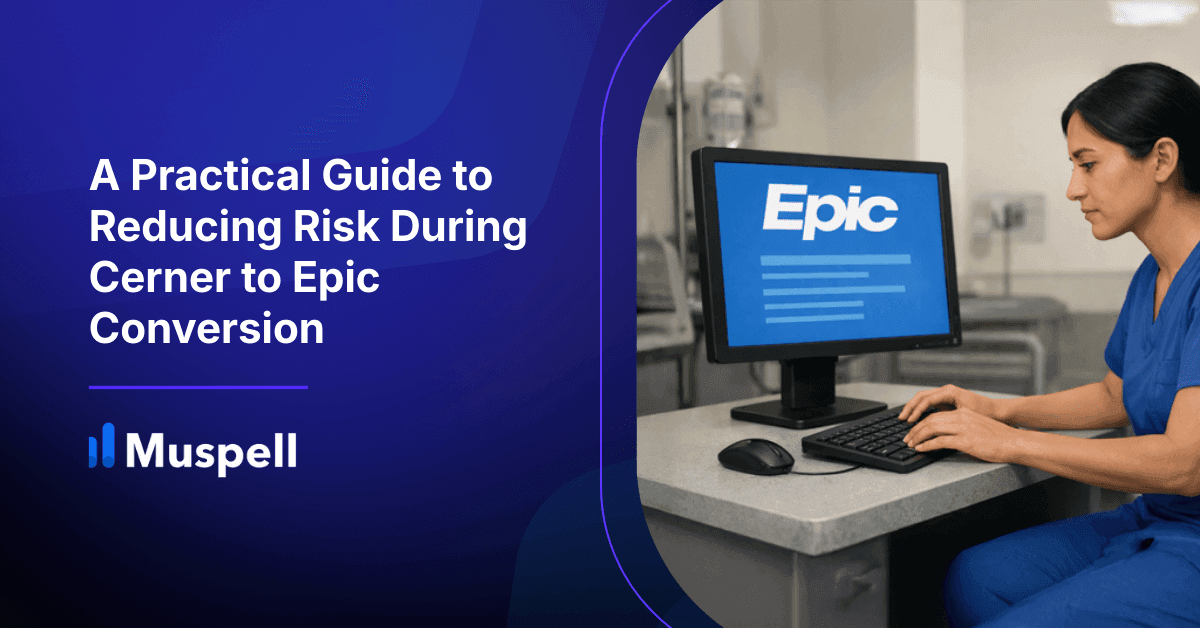
For healthcare organizations moving from Cerner Millennium to Epic, the earliest planning conversations tend to focus on familiar operational topics: timelines, interfaces, data volumes, staffing models, and go-live readiness. These discussions are logical. A Cerner to Epic transition falls under one of the largest technology initiatives most health systems undertake, often involving hundreds of stakeholders and multi-year budgets.
But those conversations, on their own, are incomplete, and increasingly dangerous.
A Cerner to Epic transition is not simply a technical data movement exercise. It is a clinical safety initiative, a legal defensibility challenge, and an organizational trust test. When handled incorrectly, the consequences extend far beyond missed milestones or delayed cutovers. They surface later as clinician frustration, audit exposure, information-blocking risk, prolonged dependence on legacy systems, and erosion of confidence in the EHR itself.
This is why experienced healthcare IT leaders are beginning to reframe the Cerner to Epic conversion as a risk management problem, not a data plumbing problem. The central question is no longer whether data can be moved, but whether it can be moved in a way that preserves clinical fidelity, withstands regulatory scrutiny, and supports long-term confidence across clinical, operational, and compliance teams.
Explore:
For decades, EHR transitions have been framed primarily as technical undertakings. Data is extracted, transformed, mapped, validated, and loaded. Interfaces are tested. Cutover plans are rehearsed. Readiness is assessed using defect counts and interface success rates.
This framing is comfortable because it is familiar. It fits neatly into traditional IT governance models and project management frameworks. But it fundamentally misrepresents the nature of clinical data.
Clinical data is not interchangeable. It carries context, provenance, interpretation, and legal weight. A medication list is not simply a set of codes. A clinical note is not just text. A lab result is not meaningful without its ordering context, reference ranges, timestamps, and authentication. Each element is part of a longitudinal medical record that clinicians, auditors, regulators, and patients rely on to be complete, accurate, and defensible.
When clinical data is mishandled during conversion, the impact is rarely immediate or obvious. Instead, risk accumulates quietly:
None of these risks appear in interface logs or conversion dashboards. They only become visible after Epic is live and relied upon for real care delivery.
Most organizations begin Cerner to Epic planning by asking a single, deceptively simple question: “What data should we convert into Epic?”
In reality, every Cerner to Epic program must manage three parallel and deeply interdependent workstreams, each with its own objectives, stakeholders, and risk profile:
Data conversion defines what information is available natively inside Epic at go-live. This is not just for clinical continuity, but for downstream workflows that depend on structured, actionable data.
At an executive level, conversion risk is less about volume and more about clinical dependency. Converting “too much” introduces cost, delay, and testing complexity. Converting “too little” shifts the clinical burden onto archive access, increases context switching, and can introduce patient safety risks in time-sensitive care settings.
The most common failure pattern is treating conversion as a data migration exercise, rather than a care-enablement decision. What truly matters is:
When conversion decisions are made without alignment to archival and financial strategies, critical gaps emerge. Organizations discover, often too late, that what was excluded from Epic is still required for care delivery, audits, or litigation.
Clinical data archival determines how the legal medical record is preserved, accessed, and defended once Cerner is decommissioned. This is not a storage decision; it is a risk transfer decision.
At scale, archival risk emerges from three factors executives routinely underestimate:
Archival readiness directly influences how aggressively the conversion scope can be optimized. If archival access is slow, incomplete, or poorly integrated, clinicians will demand broader conversion, and IT will pay the price. Conversely, a robust, clinically usable archive enables tighter conversion decisions without compromising care or compliance.
When archival planning lags behind conversion timelines, Cerner contracts are extended to maintain access. Anticipated savings disappear, while operational and compliance risks persist.
AR rundown governs how financial activity tied to Cerner is closed out. This includes claims, denials, audits, and residual balances, without compromising revenue integrity.
While often treated as a finance-only workstream, AR decisions have direct implications for clinical data access and system decommissioning. Incomplete coordination frequently results in:
These workstreams are commonly planned and executed independently, often by different vendors, under separate contracts, and on misaligned timelines. While this may simplify procurement, it introduces systemic risk.
A constrained conversion strategy increases dependency on archival access. Delayed archival readiness forces Cerner to stay live longer than planned. Uncoordinated AR rundown extends financial reliance on a system expected to be retired.
Fragmentation is not merely inefficient. It is the primary driver of extended Cerner lifespans, escalating costs, and avoidable compliance exposure.
Reducing conversion risk does not start with deciding what to move. It starts with governing how these three workstreams are aligned, sequenced, and owned - together.
Data conversion directly determines what clinicians can see, trust, and act on inside Epic from the moment it goes live. Most organizations convert two to five years of high-value clinical data, including patient demographics, encounters, medications, allergies, problem lists, labs, imaging results, vitals, and notes. The objective is clear: clinicians should be able to work fully inside Epic without needing to reference Cerner or static documents for recent care.
When conversion is poorly executed, the consequences are immediate and enduring:
These issues do more than slow workflows. They undermine trust. Once clinicians lose confidence that Epic contains the full and accurate patient record, adoption suffers. Workarounds emerge. Shadow systems persist. The EHR becomes a source of frustration rather than enablement.
Conversion success is not measured by how many HL7 messages were transmitted or how quickly files were delivered. It is measured by whether clinicians trust Epic enough to use it as their primary system of record.
Archival is often underestimated, deprioritized, or treated as a post-go-live concern. Increasingly, this approach introduces material legal and regulatory risk.
A true clinical archive must:
Historically, many organizations relied on technical infeasibility exceptions to justify limited access to legacy data. That tolerance is shrinking. Regulatory scrutiny around information blocking is increasing, and expectations are becoming explicit: patients must have timely, electronic access to their records, even if those records originated in Cerner.
When archival is delayed, incomplete, or disconnected from Epic workflows, organizations face:
Archiving is no longer a back-office afterthought. It is a compliance strategy with direct implications for cost, risk, and organizational credibility.
Cerner Millennium’s architecture reflects decades of clinical data storage practices across large healthcare organizations. During a transition to Epic, this architecture introduces several non-obvious complexities that must be addressed deliberately.
Key considerations include:
Oracle Health provides access to patient data through Patient Population EHI Exports and optional extraction services. While these exports are required by regulation, they are not designed to support seamless conversion or archival without substantial additional processing.
Organizations must account for:
Because Cerner data often moves through multiple stages: extraction, transformation, validation, and loading. Each stage introduces latency and coordination risk. Without early alignment across teams and vendors, these dependencies can derail timelines and inflate costs.
Many Cerner to Epic programs struggle not because the technology is inadequate, but because the overall approach lacks cohesion. Common fragmentation patterns include:
Individually, these decisions may appear reasonable. Collectively, they create operational drag. Over time, fragmentation manifests as:
These outcomes are rarely caused by a single failure. They are the cumulative effect of disconnected planning across teams, vendors, and timelines.
As organizations gain experience with large-scale EHR transitions, executive-level questions begin to evolve.
Rather than focusing on whether data can be moved, experienced CIOs, CMIOs, and compliance leaders ask whether the approach is defensible, coherent, and sustainable:
These questions reflect maturity. They shift the conversation away from mechanics and toward outcomes: clinical confidence, operational predictability, and long-term trust.
A risk-first approach treats conversion, archival, and AR rundown as one continuous data journey rather than a series of disconnected tasks.
This model emphasizes:
When executed cohesively, this approach reduces cost, compresses timelines, and, most importantly, reduces clinical and legal risk.
Epic go-lives are remembered for years.
When data is incomplete, delayed, or difficult to trust, clinicians blame the system. Patients feel the impact. Compliance teams inherit risk they did not anticipate. Confidence in the EHR erodes, and recovery is slow.
When data is coherent, accessible, and clinically faithful, Epic adoption accelerates. Clinicians gain confidence. Compliance risk is reduced. The organization moves forward with trust in its digital foundation.
A Cerner to Epic transition succeeds or fails based on data strategy coherence, not technical execution alone.
Organizations that treat conversion as a narrow IT task often inherit downstream clinical, legal, and reputational risk. Those who approach it as a patient safety, compliance, and trust initiative position themselves for long-term success.
The difference is not the size of the data set. It is how thoughtfully and cohesively the journey is designed.
Join over 3,200 subscribers and keep up-to-date with the latest innovations & best practices in Healthcare IT.
With the increased need to provide value-based care, the healthcare industry has seen a significant increase …
Digitization has revolutionized our every day, and while it is true that it has improved efficiency, it is …

On September 3, 2025, the U.S. Department of Health and Human Services (HHS) announced a major crackdown …